.avif)

.avif)
.avif)

.avif)
.avif)
.avif)
.avif)


Fertigation: precision nutrient delivery
When the process of fertilizing and watering crops are merged, it is called fertigation. A coordinated operation, fertigation delivers nutrients and water simultaneously to crops when and where it is needed most.
Fertigation is effective, economical, and environmentally responsible. It reaches its full potential when paired with a Reinke center pivot irrigation system. The industry-leading technology of Reinke provides the consistency, control, and connectivity growers need to implement this process.
How Fertigation Works
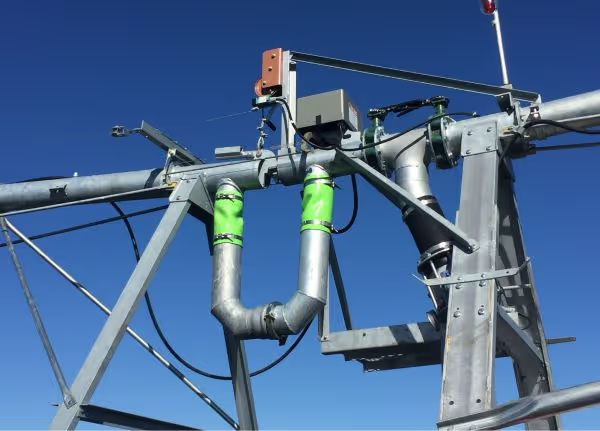
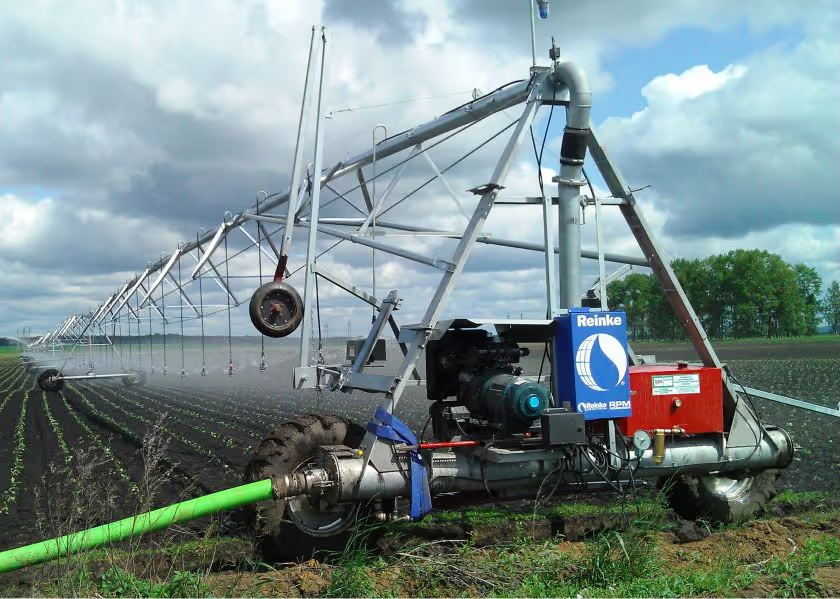
Fertilizers and soil amendments are dissolved in water and metered into the irrigation water stream using an injection pump mounted at the pivot point or pump station. Fertilizer supplies plants with the essential nutrients necessary to promote rapid, healthy growth. Amendments are materials added to soil to improve the physical, chemical, and biological properties of the soil to benefit plant growth.
The injection process involves continuously pumping a measured amount of liquid fertilizer or crop protection chemical into the main irrigation pipeline, so it is evenly distributed across the field with the water. Injection rates are carefully calibrated to achieve the desired nutrient concentration in the irrigation water, ensuring consistent delivery to crops.
The types of products applied through fertigation vary depending on crops and conditions, but can include some of the following:
- Mineral fertilizers: Nitrogen, phosphorus, potassium, and micronutrient blends formulated for fertigation use.
- Soil amendments: Products that adjust soil pH, improve nutrient availability, or enhance soil biological activity.
- Water amendments: Agents that improve water quality, such as acidifiers or surfactants that enhance infiltration.
- Plant health products: Water-soluble biologicals, growth stimulants, or crop protection materials compatible with irrigation systems.
Key Benefits
Using a center pivot irrigation system, growers can apply smaller, more frequent nutrient doses throughout the growing season, rather than large single applications. Delivery can be timed to align with specific growth stages, such as the vegetative stage, matching nutrient supply to demand, which enhances nutrient-use efficiency (NUE) by synchronizing nutrient supply with crop demand (Dixon &Liu, 2022). NUE measures how effectively crops take up and utilize essential nutrients – primarily nitrogen – to produce biomass or yield.
- Using precise timing and dosing helps to reduce over-consumption of the nutrients while preventing nutrient deficiencies, which can limit yield potential.
- Combining irrigation and fertilization into one operation, water-use efficiency is increased by reducing evaporation and ensuring the moisture reaches the root zone.
- In addition to water-use efficiency, nutrients are delivered to the active root zone, aiding in immediate plant uptake.
Growers achieve reduced nutrient losses with lower total fertilizer inputs, compared to conventional application methods. With fertigation, the terrain absorbs as much as 90%,compared to 10–40% with granular or dry fertilizer application (Ashrafi et al.,2020).
Implementing fertigation can help growers uphold their sustainability objectives and meet the guidelines of conservation programs or nutrient management plans.
Reinke Center Pivots Are Ideal
Using a Reinke center pivot for fertigation has advantages to the grower, making it a preferred choice.
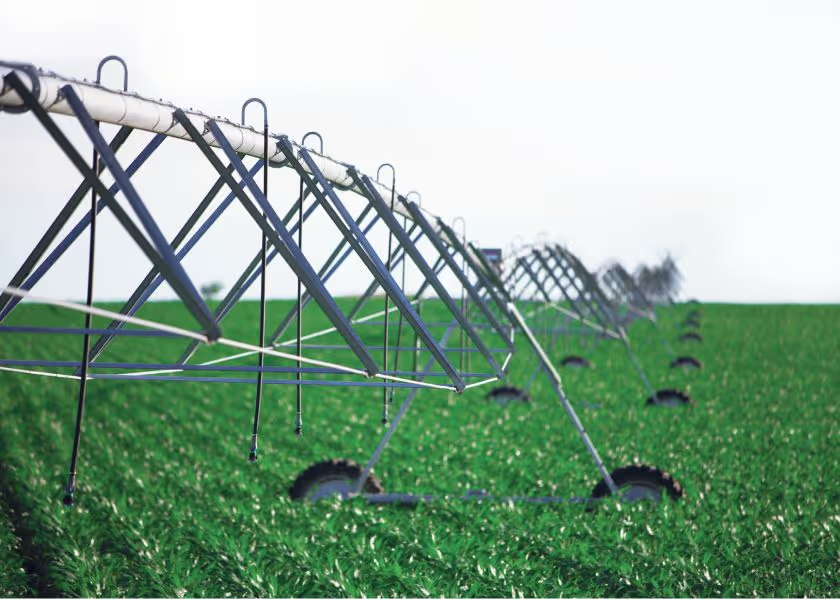
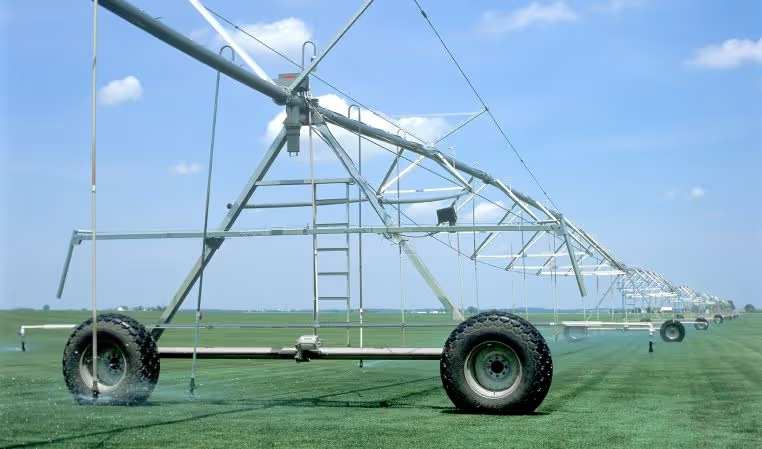
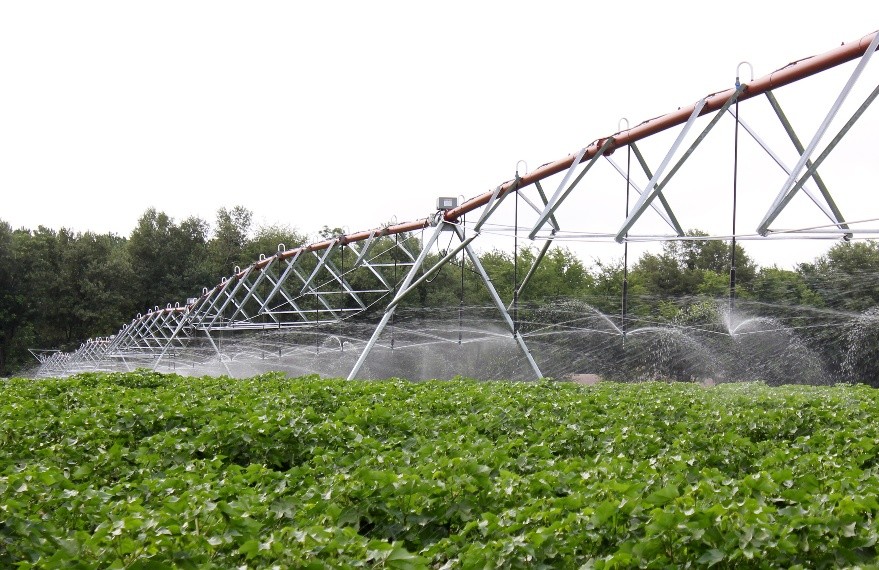
- Uniform Coverage - Reinke center pivots deliver uniform and consistent water applications across the entire field, ensuring distribution of nutrients is consistent. Center pivots support the integration of advanced sensing and precision technologies that optimize irrigation and nutrient management in modern cropping systems (Xing & Wang, 2024).
- Precision sprinkler packages are designed to work in harmony with fertigation by providing the droplet size and placement needed for effective root zone delivery.
- Precision Control - Growers precisely manage application rates, timing, and velocity, giving them direct control over the amount of fertilizer applied.
- Guess work and over-application are eliminated, due to the precise speed and timer controls on the pivot.
- Variable Rate Irrigation (VRI)Capability - Reinke’s VRI technology empowers growers to customize prescription application maps, adjusting water and nutrient delivery rates across various zones within a field.
- Soil variability, topography, and crop performance data can be used to direct more nutrients to high-yield zones or correct deficiencies in specific areas.
- Remote Monitoring and Management – With the ReinCloud® platform, growers receive alerts and notifications of system performance, helping to prevent under- or over-application due to equipment issues with the ReinCloud platform.
- Through ReinCloud, data logging provides records to support documentation for nutrient management and regulatory compliance.
Agronomic Advantages Of Using Reinke
By using a Reinke center pivot for fertigation:
- Soil compaction is reduced due to the elimination of additional equipment passes through the field for fertilizer application.
- Timely nutrients are delivered precisely when the crops can best use them during rapid growth.
- Quickly respond to in-season deficiencies or unexpected weather events and adjust the fertigation schedule accordingly.
With a Reinke center pivot, soil compaction is reduced—eliminating the need for additional equipment passes for fertilizer application. During rapid crop growth, timely nutrients are delivered precisely when the crops can best use them. Growers can quickly respond to in-season deficiencies or unexpected weather events, and adjust the fertigation schedule accordingly.
Fertigation through a Reinke pivot integrates naturally with other precision agriculture tools, such as soil sampling, grid mapping, yield monitoring, and remote sensing. This is a significant benefit for operations where multiple fertilizer applications during the growing season would otherwise require repeated equipment traffic.
The CropX monitoring sensor tool tracks soil factors like salinity and nitrogen, so the grower knows exactly what the soil needs. This tool brings knowledge to the grower for identifying when and where to apply chemicals. Fields are monitored, and systems are controlled from anywhere, reflecting a broader shift toward soil sensor technology as an effective tool for improving irrigation and nutrient management decisions (Taghvaeian et al., 2021).
The combination of Reinke technology and precision nutrient management, positions growers to continuously improve their programs based on agronomic feedback. A targeted fertigation plan can address issues before yields are impacted. This is particularly important in regions where growers participate in conservation or environmental quality incentive programs (EQIP).
Conclusion
A Reinke center pivot irrigation system is the ideal platform for fertigation - offering uniform coverage, precision control, variable rate capability, and remote management tools that growers use to run successful fertigation programs, regardless of the scale. Growers using a Reinke center pivot for fertigation are investing in a system that pays dividends every season, through healthier crops, more efficient inputs, and a stronger return on investment.
By combining precision irrigation with targeted nutrient delivery, Reinke enables growers to produce more with less—less labor, less waste, and less environmental impact. Reinke’s commitment to innovation and grower support makes it the trusted partner for producers, who are serious about doing more with precision.
References
Ashrafi, M. R., Raj, M., Shamim, S., Lal, K., & Kumar, G. (2020). Effect of fertigation on crop productivity and nutrient use efficiency. Journal of Pharmacognosy and Phytochemistry, 9(5), 2937–2942. https://www.phytojournal.com/archives/2020.v9.i5.12788/effect-of-fertigation-on-crop-productivity-and-nutrient-use-efficiency
Dixon, M., & Liu, G. (2022). The Advantages and Disadvantages of Fertigation (HS1442). University of Florida IFAS Extension. https:// https://ask.ifas.ufl.edu/publication/HS1442
Taghvaeian, S., Porter, D., & Aguilar, J. (2021). Soil Moisture-Sensing systems for Improving Irrigation Scheduling (BAE-1543). Oklahoma State University Extension. https://extension.okstate.edu/fact-sheets/soil-moisture-sensing-systems-for-improving-irrigation-scheduling.html
Xing, Y., & Wang, X. (2024). Precise application of water and fertilizer to crops: Challenges and opportunities. Frontiers in Plant Science, 15. https://doi.org/10.3389/fpls.2024.1444560